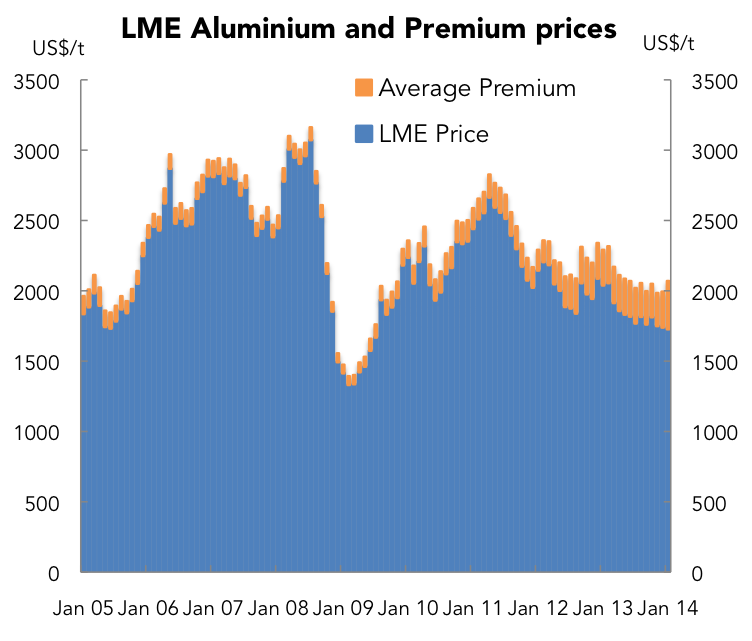
Aluminium has rallied nicely over the last quarter, although cash-3m spreads have been much more up and down than the price.
This is interesting in the context of financing deals, which has been a large component of demand in the past few years and is currently tying up a large amount of stock.
The recent gyrations in the contango is in sharp contrast to the stability seen from July 2013 up until the end of March, which was also the initial consultation period for the LME load-out rules which were delay by the UK High-Court.
While "affected" warehouses are under no additional obligations at present, the Goldman-owned Metro warehouses in Detroit continue to load out metal anyway. Cancelled warrants now account for almost 90% of metal at this location.
The story is different at the Pacorini/Glencore warehouses at Vlissingen, which continues to see inflows, albeit at a much slower rate than early April.
With the Ali contango more variable and with Metro warehouses appearing to be not interested in these deals regardless, the incentives for financing deals appear to have diminished.
In this context, its interesting that the premiums for delivery are very high in all locations.
Perhaps this is just a case of an aspect of the market that has yet to adjust to lower financing demand from affected warehouses.
But it also perhaps speaks to the improvement in manufacturing demand for aluminium as well. The latest earnings report from Alcoa puts the market deficit at almost 1million tonnes for 2014 given 7% demand growth and curtailments at smelters.
Stronger demand and a fall in absolute inventories means that there has been a small, but meaningful decrease in global aluminium inventories. Furthermore, not all of this inventory is particularly liquid, supporting tighter spot markets.
Aluminium prices can't continue to rally with reckless abandon as slower supply growth is still key to the market deficit. It also seems likely that the contango in Aluminium can't flip into a prolonged backwardation too soon, as that would see financing deals unwind at a more meaningful pace.
But market fundamentals do support better aluminium prices, with perhaps more upside at the expense of physical premiums.
Showing posts with label warehousing. Show all posts
Thursday, 10 July 2014
Aluminium prices and premiums pick up
I am an economics and commodities analyst currently working in New York City. Views expressed on this blog represent those of the author.
Please contact me for permission if you wish to use any of this information on this blog.
Thursday, 5 June 2014
Goldman's Metro warehouses voluntarily complying with LME load-out rules
MetalBulletin have reported that the Goldman Sachs-owned Metro warehousing unit is currently voluntarily complying with the LME load-out rules which were put on hold thanks to a court challenge from Rusal.
This is most relevant for aluminium loadings in and out of Detriot, which is operated by Metro and is an "affected" warehouse given the amount of metal there and the huge amount of cancelled warrants.
It is notable that in the last month, load-outs have actually been at a faster pace than the LME rules would require, averaging over 3.5kt per day over May.
With this business on sale for Goldman's, it appears to be a case that the Bank does not want to complicate any potential regulatory fall-out that is accompanying concerns about how some warehouses are operated.
This isn't the case for the other affected ali warehouse in Vlissingen, operated by the Glencore owned Pacorini. Net metal has been loaded into the warehouse as soon as the new LME rules were overruled back in late March.
Funnily enough, cancelled warrants have actually been falling in Vlissingen but not in Detroit, where queues for metal have remained the same. This isn't a sign that the voluntary adoption of the rules are not working, but more that more owners of metal are cancelling warrants now that metal is finally being loaded out on net.
The market impact of this divergence has been meaningful. Premiums in Europe have been hitting all time highs, while US markets remain more subdued (as posted here).
It's also interesting that the Cash-3m contango has collapsed in the last week or so as prices have rallied somewhat, in a very similar manner to when the LME rules were supposed to take effect back in April.
This is probably a sign of broader market tension for aluminium, but these dynamics are nonetheless having a material impact on prices, spreads and premiums.
This is most relevant for aluminium loadings in and out of Detriot, which is operated by Metro and is an "affected" warehouse given the amount of metal there and the huge amount of cancelled warrants.
It is notable that in the last month, load-outs have actually been at a faster pace than the LME rules would require, averaging over 3.5kt per day over May.
With this business on sale for Goldman's, it appears to be a case that the Bank does not want to complicate any potential regulatory fall-out that is accompanying concerns about how some warehouses are operated.
This isn't the case for the other affected ali warehouse in Vlissingen, operated by the Glencore owned Pacorini. Net metal has been loaded into the warehouse as soon as the new LME rules were overruled back in late March.
Funnily enough, cancelled warrants have actually been falling in Vlissingen but not in Detroit, where queues for metal have remained the same. This isn't a sign that the voluntary adoption of the rules are not working, but more that more owners of metal are cancelling warrants now that metal is finally being loaded out on net.
The market impact of this divergence has been meaningful. Premiums in Europe have been hitting all time highs, while US markets remain more subdued (as posted here).
It's also interesting that the Cash-3m contango has collapsed in the last week or so as prices have rallied somewhat, in a very similar manner to when the LME rules were supposed to take effect back in April.
This is probably a sign of broader market tension for aluminium, but these dynamics are nonetheless having a material impact on prices, spreads and premiums.
I am an economics and commodities analyst currently working in New York City. Views expressed on this blog represent those of the author.
Please contact me for permission if you wish to use any of this information on this blog.
Sunday, 18 May 2014
Aluminium premiums rise, nickel stocks build, copper spreads widen
Aluminium premiums in Europe have hit record highs according to Metal Bulletin of ~$400/t this week. Premiums elsewhere have been steady.
We have seen the Aluminium contango steepen in the last few weeks as the price has fallen, with cash-3m spread back at the 2.5% range we saw for most of the last 9-12 months. This has made financing deals all the more attractive.
Some warehouses appear to be taking advantage of this, with Vlissingen accumulating metal since it was announced that LME load-out rules would not take effect thanks to a high court ruling. This has likely supported the rise in European premiums.
Warehouses in Detroit, however, don't appear to be taking advantage of this though, with no new metal entering this affected location for quite sometime, with there now a significant cumulative outflow from 1 July 2013.
And while its hard to discern on the chart opposite, it also appears that deliveries have speed up, with load-outs currently in excess of the 3,000tpd as mandated by the LME for a warehouse holding such a large amount of metal.
Nickel prices have been wild in the last week, with speculative activity causing massive swings in the price. Indeed, the huge rally on news that Vale's VNC disruption a week was ridiculous given the frequency of outages there.
Its also clear that the current market balance is not particularly tight, with LME inventories yet to show a meaningful decline. These inventories have become more concentrated in Johor and Rotterdam though.
Its also interesting that while inventories haven't really fallen, cancelled warrants have actually come down a little. Perhaps there has been some re-warranting of metal as holders wait to see just how high prices can go.
This high level of concentration of LME stock shouldn't be too much of a barrier for it to clear when holders wish to move it. As we saw in copper, there wasn't really a bottleneck once participants decided to move metal.
Give the curve for nickel hasn't really changed that much as prices have rallied, perhaps that is a better way to play the longer term implications of the loss of Indonesian nickel ore from the market.
Asian copper stocks are now incredibly low, even when including SHFE inventory. Metal is flowing from New Orleans fairly freely, even though it is an "affected" warehouse.
Copper prices have rallied strongly in the last two weeks, shrugging off the negative macro news and focussing on near term tightness for cathode. As I wrote about here, this should see the backwardation in copper widen, which it has done over the last two weeks.
We have seen the Aluminium contango steepen in the last few weeks as the price has fallen, with cash-3m spread back at the 2.5% range we saw for most of the last 9-12 months. This has made financing deals all the more attractive.
Some warehouses appear to be taking advantage of this, with Vlissingen accumulating metal since it was announced that LME load-out rules would not take effect thanks to a high court ruling. This has likely supported the rise in European premiums.
Warehouses in Detroit, however, don't appear to be taking advantage of this though, with no new metal entering this affected location for quite sometime, with there now a significant cumulative outflow from 1 July 2013.
And while its hard to discern on the chart opposite, it also appears that deliveries have speed up, with load-outs currently in excess of the 3,000tpd as mandated by the LME for a warehouse holding such a large amount of metal.
Nickel prices have been wild in the last week, with speculative activity causing massive swings in the price. Indeed, the huge rally on news that Vale's VNC disruption a week was ridiculous given the frequency of outages there.
Its also clear that the current market balance is not particularly tight, with LME inventories yet to show a meaningful decline. These inventories have become more concentrated in Johor and Rotterdam though.
Its also interesting that while inventories haven't really fallen, cancelled warrants have actually come down a little. Perhaps there has been some re-warranting of metal as holders wait to see just how high prices can go.
This high level of concentration of LME stock shouldn't be too much of a barrier for it to clear when holders wish to move it. As we saw in copper, there wasn't really a bottleneck once participants decided to move metal.
Give the curve for nickel hasn't really changed that much as prices have rallied, perhaps that is a better way to play the longer term implications of the loss of Indonesian nickel ore from the market.
Asian copper stocks are now incredibly low, even when including SHFE inventory. Metal is flowing from New Orleans fairly freely, even though it is an "affected" warehouse.
Copper prices have rallied strongly in the last two weeks, shrugging off the negative macro news and focussing on near term tightness for cathode. As I wrote about here, this should see the backwardation in copper widen, which it has done over the last two weeks.
I am an economics and commodities analyst currently working in New York City. Views expressed on this blog represent those of the author.
Please contact me for permission if you wish to use any of this information on this blog.
Monday, 28 April 2014
LME nickel inventory following the path set by copper in 2013?
LME nickel inventories have fallen, although do remain at high levels. They have, however, become more concentrated particular in Johor. This may not be dissimilar to the experience of copper in 2013, with the current low level of copper stocks showing that hoarding doesn't last forever.
Aluminium stocks continue to grow at Vlissengen, although have seen net outflows in Detroit.
The Pacorini/Glencore warehouse operation in Johor in particular has accumulated quite a lot of nickel in the last few months, rising by ~22.5kt since the start of the year. These warehouses have also seen a sharp rise in cancelled warrants, currently accounted for over a quarter of total LME nickel stock.
This rapid expansion and stock and cancelled warrants at Johor is something we have already seen occur in copper. Through 2013, Johor copper stocks rose sharply, with cancelled warrants rising to ~30% of total LME inventories.
But as we have seen in the last 6 months or so, this concentration/hoarding behaviour isn't necessarily a barrier to the withdrawal of metal. Johor copper stocks are now down to just 16kt.
The incentives to move nickel are perhaps a little different to the copper story. It made sense to deliver copper into China given the surge in Shanghai copper premiums in 2H13, which would have provided a tidy return.
For nickel it is probably not just about premiums given the dramatic shift in the outlook for nickel since the ban on Indonesian ore. Given how sharply the nickel price can move on stocking cycles for both raw materials and for stainless steel, some holders of metal are likely to see how high prices can get before delivering.
Total aluminium inventory has been stable, although Vlissingen continues to accumulate more metal since the High Court ruling on the new LME load-out rules.
Detroit, however, hasn't seen any new inflow in the last few weeks and has actually now seen net outflow of metal since July 2013. Perhaps this speaks to the withdrawal of US banks from commodities markets.
The cash-3m contango in aluminium prices has bounced back up a bit more recently, although does remain below the ~2.5% level seen prior to the end of March. This lower level of ~2% still is still very attract rate for finance deals.
Aluminium stocks continue to grow at Vlissengen, although have seen net outflows in Detroit.
The Pacorini/Glencore warehouse operation in Johor in particular has accumulated quite a lot of nickel in the last few months, rising by ~22.5kt since the start of the year. These warehouses have also seen a sharp rise in cancelled warrants, currently accounted for over a quarter of total LME nickel stock.
This rapid expansion and stock and cancelled warrants at Johor is something we have already seen occur in copper. Through 2013, Johor copper stocks rose sharply, with cancelled warrants rising to ~30% of total LME inventories.
But as we have seen in the last 6 months or so, this concentration/hoarding behaviour isn't necessarily a barrier to the withdrawal of metal. Johor copper stocks are now down to just 16kt.
The incentives to move nickel are perhaps a little different to the copper story. It made sense to deliver copper into China given the surge in Shanghai copper premiums in 2H13, which would have provided a tidy return.
For nickel it is probably not just about premiums given the dramatic shift in the outlook for nickel since the ban on Indonesian ore. Given how sharply the nickel price can move on stocking cycles for both raw materials and for stainless steel, some holders of metal are likely to see how high prices can get before delivering.
Total aluminium inventory has been stable, although Vlissingen continues to accumulate more metal since the High Court ruling on the new LME load-out rules.
Detroit, however, hasn't seen any new inflow in the last few weeks and has actually now seen net outflow of metal since July 2013. Perhaps this speaks to the withdrawal of US banks from commodities markets.
The cash-3m contango in aluminium prices has bounced back up a bit more recently, although does remain below the ~2.5% level seen prior to the end of March. This lower level of ~2% still is still very attract rate for finance deals.
I am an economics and commodities analyst currently working in New York City. Views expressed on this blog represent those of the author.
Please contact me for permission if you wish to use any of this information on this blog.
Monday, 14 April 2014
Aluminium warehouse queues get bigger, contango collapses
The recent indefinite delay to the LME load-out rules has seen a notable drop in the cash - 3m contango in the last week or so, with cash prices also rallying. Premiums are edging higher, while there are signs of renewed financing deals at "affected" warehouses.
There is still a large incentive to roll existing and enter into new financing deals even though the contango has narrowed. It seems likely that we will see fresh hoarding of metal at Detroit as well.
While prices have rallied to similar levels seen in 2H13, the 3 month contango has fallen well below 2% after spending most of the last 9 months at ~2.5%.
The jump in the contango in 2013 seemed to be a function of risk created by the new load-out rules that were supposed to come into affect as of 1 April, although are now delayed thanks to a UK high court decision.
But now it appears that warehouses with large queues for metal are back in the game for accumulating more financed metal. This has pushed premiums a little higher again and has tightened spreads.
Indeed, queues for metal at Vlissingen have jumped sharply as cancelled warrants have surged to record highs.
There has also been fresh metal delivered to the warehouse, with a cumulative 32.5k of metal in the last week or so. This is the first meaningful inflow since the middle of January.
Detroit has yet to see the same kind of dynamic, with no new metal entering warehouses at this location. Indeed, we are now close to cumulative outflow of metal since 1 July 2013.
There is still a large incentive to roll existing and enter into new financing deals even though the contango has narrowed. It seems likely that we will see fresh hoarding of metal at Detroit as well.
To some degree this may help spreads tighten further given increasing competition from different parts of demand. But spreads are likely to remain in contango, with the market still requiring financing demand to sustain current all-in aluminium prices.
I am an economics and commodities analyst currently working in New York City. Views expressed on this blog represent those of the author.
Please contact me for permission if you wish to use any of this information on this blog.
Thursday, 27 March 2014
Rusal high court win delays LME loading rule changes
The UK High Court of Justice has upheld a complaint about the LME's consultation process regarding changes to load-out rules and subsequently they will no longer come into effect as of April 1. This will have significant consequences for the aluminium market, with incentives around financing deals and premiums shifting. The LME press release can be found here.
This should ensure that premiums remain higher for longer.
The Court ruled in favour of Rusal on the issue that the LME consultation did not encompass or make reference to the banning or capping of rents. So the ruling is not so much against the new rules themselves, but more an issue with the process.
So what does this mean? For the aluminium market, the big change is that "affected" warehouses, which in the case of aluminium are Detroit and Vlissingen, are now more likely to again start accumulating metal under financing deals, as there will be no immediate repercussions in terms of having to load-out the metal.
As I posted here, both these warehouses were on track to have little net inflow from 1 July 2013 to 1 April, which was the start of the first calculation period.
Vlissingen had seen very little net inflow after load-ins dried up since early January.
Detroit had a larger requirements under the previous timetable, but had also not seen any significant load-ins since February.
To be sure, aluminium premiums for delivery sky-rocketed which Detriot and Vlissingen sure large inflows back in November/December and have been more stable since these warehouses have delivering metal out over Jan/Feb. The risk is that
This news is not bullish for LME aluminium prices, as it means that premiums will continue to support producers at a time when a bit more supply discipline would be welcome.
While the focus will be on aluminium, there are warehousing issues emerging in other metals as well. For example, queues for nickel at LME warehouses have expanded rapidly in the past few months.
While only Johor would have been considered an "affected" warehouse under the previous timetable, this legal challenge to rule changes will affect the LMEs ability to deal with this emerging issue.
To be sure, with LME nickel inventories are still rising, it suggests hoarding is playing a role in the recent rally in nickel prices and premiums.
While I am not a legal expert, there is also the issue of potential further legal action against the LME that could further delay changes. While this outcome seems to be more about the process than the rules themselves, subsequent legal challenges could provide more unexpected hurdles for rule changes to take effect.
This will reduce the risk for affected warehouses entering into financing deals or other hoarding behaviour.
This should ensure that premiums remain higher for longer.
The Court ruled in favour of Rusal on the issue that the LME consultation did not encompass or make reference to the banning or capping of rents. So the ruling is not so much against the new rules themselves, but more an issue with the process.
So what does this mean? For the aluminium market, the big change is that "affected" warehouses, which in the case of aluminium are Detroit and Vlissingen, are now more likely to again start accumulating metal under financing deals, as there will be no immediate repercussions in terms of having to load-out the metal.
As I posted here, both these warehouses were on track to have little net inflow from 1 July 2013 to 1 April, which was the start of the first calculation period.
Vlissingen had seen very little net inflow after load-ins dried up since early January.
Detroit had a larger requirements under the previous timetable, but had also not seen any significant load-ins since February.
To be sure, aluminium premiums for delivery sky-rocketed which Detriot and Vlissingen sure large inflows back in November/December and have been more stable since these warehouses have delivering metal out over Jan/Feb. The risk is that
This news is not bullish for LME aluminium prices, as it means that premiums will continue to support producers at a time when a bit more supply discipline would be welcome.
While the focus will be on aluminium, there are warehousing issues emerging in other metals as well. For example, queues for nickel at LME warehouses have expanded rapidly in the past few months.
While only Johor would have been considered an "affected" warehouse under the previous timetable, this legal challenge to rule changes will affect the LMEs ability to deal with this emerging issue.
To be sure, with LME nickel inventories are still rising, it suggests hoarding is playing a role in the recent rally in nickel prices and premiums.
While I am not a legal expert, there is also the issue of potential further legal action against the LME that could further delay changes. While this outcome seems to be more about the process than the rules themselves, subsequent legal challenges could provide more unexpected hurdles for rule changes to take effect.
This will reduce the risk for affected warehouses entering into financing deals or other hoarding behaviour.
I am an economics and commodities analyst currently working in New York City. Views expressed on this blog represent those of the author.
Please contact me for permission if you wish to use any of this information on this blog.
Thursday, 20 March 2014
Aluminium: affected warehouses delivering metal, huge increase at Rotterdam
Deliveries from affected warehouses holding large quantities of aluminium have been steady, with the net inflow since 1 July 2013 now small. This means that the additional load-out requirement in May - July aren't likely to be overly onerous.
Outflow from these warehouses over the past month or so has taken the edge off premiums, although they still remain elevated.
Deliveries into Rotterdam rose by a massive 217k on the 18th of March, the largest daily increase in exchange history. It has been suggested that this is due to sale of JP Morgan's commodities unit to Mercuria, with off-warrant material at Rotterdam becoming visible.
Over the last month or so, the two prominent "affected" warehouses holding aluminium have seen cumulative inflows since mid-2013 narrow. This is important as this will define any additional load-out requirement under new LME rules.
At Vlissigen, if the current pace of load-outs is maintained till the end of March and no new metal shows up on warrant, then the cumulative inflow since 1 July will be ~27kt. This will have to be withdrawn over May - July in addition to the baseline of 3,000tpd.
At Detroit, the requirement look like it will be a little larger at ~33kt. But this is a large improvment from just a few months ago, with the jump in cancelled warrants suggesting more metal that were under finance deals is ready to exit the warehouse.
The appearance of 217kt at Rotterdam on-warrant perhaps speaks to some of the murkier aspects of
Aluminium finance deals. It seems likely that this metal was tied up in financing off-warrant at Rotterdam, with it potentially unwound as the metal changed hands.
In some ways, the attractiveness of these deals remain unchanged, with the contango in the curve remaining steep and financing costs low. A major stumbling block, however, is hedging the premium risk.
Warehouses outside of Vlissigen and Detroit don't generate the same revenues given queues are shorter, while these two warehouses don't look to be accumulating more metal.
Financing deals can certainly be done outside of LME warehouses, but for it to be a risk free trade, someone has to hedge the premium. Given they are currently very high and could come down quite a bit, there is likely to be caution into heading into these kinds of deals in the next few months.
I am an economics and commodities analyst currently working in New York City. Views expressed on this blog represent those of the author.
Please contact me for permission if you wish to use any of this information on this blog.
Friday, 14 February 2014
Rolling Stone weighs in on metals warehousing
Rolling Stone Magazine's Matt Taibbi is the latest journalist to take a stab at the controversy surrounding banks owning metal warehouses and commodity assets in general, with his article available here. Taibbi brings his usual sense of outrage to anything banks are involved in, while Izabella Kaminska from FT Alphaville does a good takedown here.
I have written about metal warehousing here, but there are a couple of points worth adding. There is not a lot of evidence to suggest that banks, or trading houses owning these assets are making metal prices high. Yes, aluminium premiums are high, but the LME price is incredibly low. Only copper and lead prices remain high from a recent historical perspective, but it would be a stretch to suggest that is due to warehousing issues given inventory is low. Even for metals where trading houses like GlencoreXstrata control a large degree of supply like zinc or nickel, prices are low.
Also, its not just owners of warehouses that benefit from rents or traders from higher premiums, but producers also capture the benefit of very high aluminium premiums. And with LME aluminium at very low levels, strong premiums are helping keeping many producers in business. The alternative to this story is the death of a large chunk of North American aluminium production.
The situation with other base metals is different to the extreme case of aluminium. Zinc does have some financing deals tying up metal in warehouses, but for copper and nickel this is not the case. The issue here is that metal has been concentrated into a few locations which are operated by Pacorini/Glencore, but this is not a riskless enterprise like financing deals are.
Finally I would add that the LME rule changes haven't affect premiums because at this stage they are not binding. That changes as of the 1st of April, when warehouses like Vlissingen and Detroit will have to load out the culmulative additional metal that have gone into these warehouses since 1 July 2013. At the moment this stands at ~230kt.
So while the rule changes won't affect incentives for financing deals, they should affect the concentration of metal in warehouses and subsequently premiums.
Also, its not just owners of warehouses that benefit from rents or traders from higher premiums, but producers also capture the benefit of very high aluminium premiums. And with LME aluminium at very low levels, strong premiums are helping keeping many producers in business. The alternative to this story is the death of a large chunk of North American aluminium production.
The situation with other base metals is different to the extreme case of aluminium. Zinc does have some financing deals tying up metal in warehouses, but for copper and nickel this is not the case. The issue here is that metal has been concentrated into a few locations which are operated by Pacorini/Glencore, but this is not a riskless enterprise like financing deals are.
Finally I would add that the LME rule changes haven't affect premiums because at this stage they are not binding. That changes as of the 1st of April, when warehouses like Vlissingen and Detroit will have to load out the culmulative additional metal that have gone into these warehouses since 1 July 2013. At the moment this stands at ~230kt.
So while the rule changes won't affect incentives for financing deals, they should affect the concentration of metal in warehouses and subsequently premiums.
I am an economics and commodities analyst currently working in New York City. Views expressed on this blog represent those of the author.
Please contact me for permission if you wish to use any of this information on this blog.
Tuesday, 28 January 2014
Soaring aluminium premiums creating additional risks
Aluminium premiums have skyrocketed in the last couple of months. A combination of better demand from consumers and for financing deals has squeezed physical availability.
This has meant the total delivered aluminium price has been a stronger, despite very weak LME prices.
However, high premiums as a proportion of total prices creates risks for all market participants as this cannot be hedged and is likely to be affected by non-market forces.
Aluminium prices have moved in a saw-tooth pattern since late 2013 and are currently back in the bottom end of the range. The contango from cash to 3-month prices has remained fairly consistent through this period, at ~2.5-2.7%.
While cash prices have been choppy in a ~$50/t range, premiums for delivery have skyrocketed. Reported premiums by the likes of Metal Bulletin and Platts have surged at the turn of the year, rising by ~$80/t, on average, in January.
Ultimately stronger premiums are supporting producers, of which ~50% of the cost curve wouldn't make a return at the LME price alone. Its also a windfall for traders who can access spot tonnes and move physical metal.
That said, the risks too producer profits in particular are much higher when the the premium is such a large component of the delivered price, because premiums cannot be hedged. There is one financial contract for US midwest premiums traded on the CME, but volumes are very very small.
Furthermore, the premiums could shift dramatically on events that have very little to do with market mechanisms. In particular, the change LME load-out rules should have a significant impact of large LME listed warehouses holding metal in financing deals, of which the warehouses tend to cover the premium risk.
In the last month or so, both Detroit and Vlissingen have accumulated more metal. Vlissingen has seen sizeable net inflows despite maintaining the 3,000tpd load out as stipulated for a warehouse holding large amounts of metal. Cancelled warrants are a little lower over the last few days, but remain close to all time highs.
The situation at Detroit is much more severe, with cancelled warrants vastly higher than mid-2013 levels. Load-out rate have also been quite a bit below the 3,000tpd rate they are supposed to be, which is curious given the apparent squeeze for physical metal.
At the current run rates, these warehouses will have to see net withdrawals as we enter the preliminary period in 1 May for additional load-out requirements. These will become more stringent after three months after the first calculation period is over (see this post).
If anything, the current increase in queues and premiums seem like a final rush into financing deals in LME warehouses before the rules become more binding. But once the rules do become more restrictive, it seems likely that premiums will fall sharply as those warehouses will large queues will not have the same ability to cover high premiums for delivery for financing deals as they do now.
This is important even if the contango in the aluminium market remains very steep. While there is still a huge incentive for fully-hedged financing deals, these will only be interesting to current players if the premium risk is also hedged. If not, returns could be completely wiped-out by a drop in the premium, which defeats the purpose of engaging in a hedged-carry trade strategy in the first place.
Metal coming out of Detroit and Vlissingen could end up in other LME or non-LME locations. But these warehouses won't have the same ability to cover premiums for carry trades as Vlissingen or Detroit given they are not collecting rent on queued metal.
The diagram above maps what impact the change in load-out requirements should have in theory on prices. The delivered aluminium price is the LME price and the premium and is a function of supply and demand. Demand is in turn a function of end use markets and demand for carry trades.
Critically, carry trades are only a function of the risk-free contango and not premiums. So the change in load-out rules shouldn't have an effect on carry trade demand.
But it does reduce warehouse queues, which does impact the ability for warehouses to cover premiums as revenue is reduced.
This diagram also assumes that increased availability from affected warehouses doesn't constitute additional supply. This may not make immediate sense, as rules aimed at reducing queues could be seen as increasing available metal.
But an alternative way to think of it as rather than increasing supply, you are affecting the purchasing power of warehouses to cover premiums. This is a subtle difference, but is important when thinking about the impact on LME prices.
If hoarding of metal via carry trades is merely shifted into warehouses with lower ability to cover premiums, then it doesn't really impact the demand and supply balance. Subsequently, the LME price should really go up to cover the fall in premiums.
This is of course assumes everything else is equal, which is rarely the case. But it does provide a framework for how flat prices should rise once the LME rules become binding.
However, high premiums as a proportion of total prices creates risks for all market participants as this cannot be hedged and is likely to be affected by non-market forces.
Aluminium prices have moved in a saw-tooth pattern since late 2013 and are currently back in the bottom end of the range. The contango from cash to 3-month prices has remained fairly consistent through this period, at ~2.5-2.7%.
While cash prices have been choppy in a ~$50/t range, premiums for delivery have skyrocketed. Reported premiums by the likes of Metal Bulletin and Platts have surged at the turn of the year, rising by ~$80/t, on average, in January.
Ultimately stronger premiums are supporting producers, of which ~50% of the cost curve wouldn't make a return at the LME price alone. Its also a windfall for traders who can access spot tonnes and move physical metal.
That said, the risks too producer profits in particular are much higher when the the premium is such a large component of the delivered price, because premiums cannot be hedged. There is one financial contract for US midwest premiums traded on the CME, but volumes are very very small.
Furthermore, the premiums could shift dramatically on events that have very little to do with market mechanisms. In particular, the change LME load-out rules should have a significant impact of large LME listed warehouses holding metal in financing deals, of which the warehouses tend to cover the premium risk.
In the last month or so, both Detroit and Vlissingen have accumulated more metal. Vlissingen has seen sizeable net inflows despite maintaining the 3,000tpd load out as stipulated for a warehouse holding large amounts of metal. Cancelled warrants are a little lower over the last few days, but remain close to all time highs.
The situation at Detroit is much more severe, with cancelled warrants vastly higher than mid-2013 levels. Load-out rate have also been quite a bit below the 3,000tpd rate they are supposed to be, which is curious given the apparent squeeze for physical metal.
At the current run rates, these warehouses will have to see net withdrawals as we enter the preliminary period in 1 May for additional load-out requirements. These will become more stringent after three months after the first calculation period is over (see this post).
If anything, the current increase in queues and premiums seem like a final rush into financing deals in LME warehouses before the rules become more binding. But once the rules do become more restrictive, it seems likely that premiums will fall sharply as those warehouses will large queues will not have the same ability to cover high premiums for delivery for financing deals as they do now.
This is important even if the contango in the aluminium market remains very steep. While there is still a huge incentive for fully-hedged financing deals, these will only be interesting to current players if the premium risk is also hedged. If not, returns could be completely wiped-out by a drop in the premium, which defeats the purpose of engaging in a hedged-carry trade strategy in the first place.
Metal coming out of Detroit and Vlissingen could end up in other LME or non-LME locations. But these warehouses won't have the same ability to cover premiums for carry trades as Vlissingen or Detroit given they are not collecting rent on queued metal.
The diagram above maps what impact the change in load-out requirements should have in theory on prices. The delivered aluminium price is the LME price and the premium and is a function of supply and demand. Demand is in turn a function of end use markets and demand for carry trades.
Critically, carry trades are only a function of the risk-free contango and not premiums. So the change in load-out rules shouldn't have an effect on carry trade demand.
But it does reduce warehouse queues, which does impact the ability for warehouses to cover premiums as revenue is reduced.
This diagram also assumes that increased availability from affected warehouses doesn't constitute additional supply. This may not make immediate sense, as rules aimed at reducing queues could be seen as increasing available metal.
But an alternative way to think of it as rather than increasing supply, you are affecting the purchasing power of warehouses to cover premiums. This is a subtle difference, but is important when thinking about the impact on LME prices.
If hoarding of metal via carry trades is merely shifted into warehouses with lower ability to cover premiums, then it doesn't really impact the demand and supply balance. Subsequently, the LME price should really go up to cover the fall in premiums.
This is of course assumes everything else is equal, which is rarely the case. But it does provide a framework for how flat prices should rise once the LME rules become binding.
I am an economics and commodities analyst currently working in New York City. Views expressed on this blog represent those of the author.
Please contact me for permission if you wish to use any of this information on this blog.
Monday, 13 January 2014
Storage wars come to nickel
Indonesia has decided to enforce its ban on unprocessed ores for some producers, which is particularly important to the nickel market. The use of Indonesian ores in the production of nickel in China has been the key factor contributing to the oversupply of nickel in the last few years and removing its availability has big implications for supply.
For a surprisingly detailed rundown from the Glencore perspective, this recent presentation has some great charts and tables on the costs and production rates of nickel pig iron (NPI) in China.
In particular, on the left is a table of Glencore estimates for Chinese NPI production this year. This compares to an estimated market surplus of a little over 200kt in 2013.
A dramatic reduction in NPI production would have a big impact on the market balance for nickel. But this market has been in surplus for a number of years, so its important to consider the inventory situation before contemplating what the impact is on prices.
LME inventories have been built to the highest levels in terms of days of consumption since the early 1990s. But like other base metals, this stock has been increasingly concentrated into two locations in Johor and Rotterdam.
This will create queues for metal once the market balance has been tipped into deficit, a bit like the situation seen in copper in the second half of 2013 or like for Aluminium financing demand. But for nickel this will be further compounded by the fact that Rotterdam in particular has a lot of other metal in storage. While inventory held is large compared to the nickel market, it is not the dominant metal at this location.
The LME rule changes do try to recognise this for small volume markets like nickel and tin, although the required additional load-out of these additional metals are very low at just 60tpd.
Cancelled warrants have already jumped even though the market has been in surplus, perhaps in anticipation of queues.
The warehousing situation seems likely to amplify any squeeze that might occur as a result of a loss of Indonesia ore. This will probably initially be reflected in premiums before prices move to levels that would be good news for producers.
For a surprisingly detailed rundown from the Glencore perspective, this recent presentation has some great charts and tables on the costs and production rates of nickel pig iron (NPI) in China.
In particular, on the left is a table of Glencore estimates for Chinese NPI production this year. This compares to an estimated market surplus of a little over 200kt in 2013.
A dramatic reduction in NPI production would have a big impact on the market balance for nickel. But this market has been in surplus for a number of years, so its important to consider the inventory situation before contemplating what the impact is on prices.
LME inventories have been built to the highest levels in terms of days of consumption since the early 1990s. But like other base metals, this stock has been increasingly concentrated into two locations in Johor and Rotterdam.
This will create queues for metal once the market balance has been tipped into deficit, a bit like the situation seen in copper in the second half of 2013 or like for Aluminium financing demand. But for nickel this will be further compounded by the fact that Rotterdam in particular has a lot of other metal in storage. While inventory held is large compared to the nickel market, it is not the dominant metal at this location.
The LME rule changes do try to recognise this for small volume markets like nickel and tin, although the required additional load-out of these additional metals are very low at just 60tpd.
Cancelled warrants have already jumped even though the market has been in surplus, perhaps in anticipation of queues.
The warehousing situation seems likely to amplify any squeeze that might occur as a result of a loss of Indonesia ore. This will probably initially be reflected in premiums before prices move to levels that would be good news for producers.
I am an economics and commodities analyst currently working in New York City. Views expressed on this blog represent those of the author.
Please contact me for permission if you wish to use any of this information on this blog.
Friday, 3 January 2014
Aluminium queues get bigger
Aluminium warehouses continued to accumulate metal at the end of 2013, with total LME inventories rising by ~83kt. And despite the new LME load out rules, inventory has become more concentrated at Vlissingen and Detroit, which are two warehouses which will be classified as "affected" once the new rules become binding.
Carry trades have not become any less attractive in the past few months. The contango in aluminium curve remains steep and with prices weak, these trades can pick up more metal for their dollar.
Strong interest in carry trades has also helped keep aluminium premiums high. As explained in this post, this is because the new rules are not particularly binding at present given we are still in the first calculation period. This has meant that until 31 March, warehouses are likely to load-in as much metal as they will load-out, which will only keep queues for metal at high levels rather than reduce them.
In the last few months, the two key affected warehouses for aluminium in Vlissigen and Detroit have been accumulating much more metal than they have been delivering. Since 1 Nov, Vlissingen inventory has risen by 73kt.
As shown in the chart on the left, Detroit has seen an even larger inflow of metal of 137kt over the same period.
As fresh metal has come into these warehouses, presumably under carry-trades, cancelled warrants have also risen, particularly at Detroit. Its likely that because the queue for delivery is now so long that warrants are cancelled almost as soon as metal goes in.
So far its hard to say that the new LME rules have had any impact, with queues at these warehouses actually getting bigger rather than smaller.
But this is because the rule changes are not binding yet. Once the rules become more stringent into mid-2014, premiums in particular should show more meaningful signs of weakening.
Carry trades have not become any less attractive in the past few months. The contango in aluminium curve remains steep and with prices weak, these trades can pick up more metal for their dollar.
Strong interest in carry trades has also helped keep aluminium premiums high. As explained in this post, this is because the new rules are not particularly binding at present given we are still in the first calculation period. This has meant that until 31 March, warehouses are likely to load-in as much metal as they will load-out, which will only keep queues for metal at high levels rather than reduce them.
In the last few months, the two key affected warehouses for aluminium in Vlissigen and Detroit have been accumulating much more metal than they have been delivering. Since 1 Nov, Vlissingen inventory has risen by 73kt.
As fresh metal has come into these warehouses, presumably under carry-trades, cancelled warrants have also risen, particularly at Detroit. Its likely that because the queue for delivery is now so long that warrants are cancelled almost as soon as metal goes in.
So far its hard to say that the new LME rules have had any impact, with queues at these warehouses actually getting bigger rather than smaller.
But this is because the rule changes are not binding yet. Once the rules become more stringent into mid-2014, premiums in particular should show more meaningful signs of weakening.
Like what your reading? Click here to get economic by design in your inbox
I am an economics and commodities analyst currently working in New York City. Views expressed on this blog represent those of the author.
Please contact me for permission if you wish to use any of this information on this blog.
Sunday, 24 November 2013
Taking stock: Aluminium inventory rise despite rule changes
The LME's changes to warehouse rules, that will be binding next year, have yet to make a significant impact on Aluminium price spreads or premiums.
Furthermore aluminium inventories have also gone up since the last announcement from the LME, particularly at one of the "affected" warehouses of Detroit.
While some may fear this is a sign the new rules won't work, it seems more a function that the initial calculation and discharge periods don't change the status quo too much. But this will change when requirements are more stringent next year.
There are very few analysts and commentators that are not bearish on Aluminium premiums as a result of the rule changes, which are discussed in detail in this post. In a nutshell, they should mitigate warehouse queues, which should in turn stop warehouses being able to pay cover high premiums for delivery in order to hold metal under financing deals.
But perhaps the fact that premiums haven't moved much yet is because there is still some warehouses for leeway for some warehouses to bid for metals before the first discharge period begins next year.
"Affected warehouses" with queues of more than 50 days will have to discharge the net inflow from the period 1 July 2013 to 31st of March 2014 will have to required to deliver out the additional metal over a 90 day period, on top of the 3,000 tpd required by warehouses with more than 900kt.
So there is an incentive for affected warehouses to have a no net inflow at the end of this period, to avoid this additional withdrawal requirement.
The warehouses at Vlissingen have so far seen a net inflow of 36kt during the first calculation period. So on net, they will likely looking to draw down net inventory by this amount by 31 March. But given there is still ~88 business days till then, there is still time to get metal into the warehouse and into finance deals to replace some of the cancelled warrants.
The recent experience at Detroit perhaps highlights this. Over the last 4 days, inventory here has gone up almost 90kt, which may suggest that many are not so worried about the new LME rules.
But looking back on a cumulative basis to 1 July, Detroit had seen quite a large outflow until just a few days ago. This brings net inflows into positive territory, although not drastically so at ~21kt.
To be sure, at this stage there is still the incentive to lock up Aluminium in financing deals if warehouses have leeway under the new LME rules. The cash - 3 Month contango is still steep, as it has been since mid year. Weaker Aluminium prices means that these financing deals will absorb more tonnage for the same amount of finance committed.
So while this dynamic is still in play it seems likely that Aluminium premiums will stay sticky. This is likely to change when the LME load out rules become more stringent.
This pressure will begin in the first calculation period starting 1 April 2014. This pressure arises from the requirement to load out an additional 50% of gross metal loaded in over a 90 day period.
But until then, premiums look likely to stay a bit more sticky than many may think.
Furthermore aluminium inventories have also gone up since the last announcement from the LME, particularly at one of the "affected" warehouses of Detroit.
While some may fear this is a sign the new rules won't work, it seems more a function that the initial calculation and discharge periods don't change the status quo too much. But this will change when requirements are more stringent next year.
There are very few analysts and commentators that are not bearish on Aluminium premiums as a result of the rule changes, which are discussed in detail in this post. In a nutshell, they should mitigate warehouse queues, which should in turn stop warehouses being able to pay cover high premiums for delivery in order to hold metal under financing deals.
But perhaps the fact that premiums haven't moved much yet is because there is still some warehouses for leeway for some warehouses to bid for metals before the first discharge period begins next year.
"Affected warehouses" with queues of more than 50 days will have to discharge the net inflow from the period 1 July 2013 to 31st of March 2014 will have to required to deliver out the additional metal over a 90 day period, on top of the 3,000 tpd required by warehouses with more than 900kt.
So there is an incentive for affected warehouses to have a no net inflow at the end of this period, to avoid this additional withdrawal requirement.
The warehouses at Vlissingen have so far seen a net inflow of 36kt during the first calculation period. So on net, they will likely looking to draw down net inventory by this amount by 31 March. But given there is still ~88 business days till then, there is still time to get metal into the warehouse and into finance deals to replace some of the cancelled warrants.
The recent experience at Detroit perhaps highlights this. Over the last 4 days, inventory here has gone up almost 90kt, which may suggest that many are not so worried about the new LME rules.
But looking back on a cumulative basis to 1 July, Detroit had seen quite a large outflow until just a few days ago. This brings net inflows into positive territory, although not drastically so at ~21kt.
To be sure, at this stage there is still the incentive to lock up Aluminium in financing deals if warehouses have leeway under the new LME rules. The cash - 3 Month contango is still steep, as it has been since mid year. Weaker Aluminium prices means that these financing deals will absorb more tonnage for the same amount of finance committed.
So while this dynamic is still in play it seems likely that Aluminium premiums will stay sticky. This is likely to change when the LME load out rules become more stringent.
This pressure will begin in the first calculation period starting 1 April 2014. This pressure arises from the requirement to load out an additional 50% of gross metal loaded in over a 90 day period.
But until then, premiums look likely to stay a bit more sticky than many may think.
I am an economics and commodities analyst currently working in New York City. Views expressed on this blog represent those of the author.
Please contact me for permission if you wish to use any of this information on this blog.
Subscribe to:
Posts (Atom)